
This quilt is inspired by my favorite traditional Amish design, Diamond in a Square.
Kona cotton, machine pieced and quilted. 42″ x 42″
This quilt is inspired by my favorite traditional Amish design, Diamond in a Square.
Kona cotton, machine pieced and quilted. 42″ x 42″

In reaction to the Bomb Cyclone of January 2018 that paralyzed much of the US east coast for days.
Whole cloth cotton, snow dyed with procion fiver reactive dyes, machine quilted with additional hand embroidery. 12″ x 12″
This is a study in value. I pieced each of the 108 squares as infividual blocks before sewing them together, in the manner of traditional quilting. Hand-dyed cotton, machine peiced and quilted.




So thrilled my art quilt “Kirsten” is in ArtPrize 9, a huge international art competition in Grand Rapids, Michigan!

“Kirsten”
“Kirsten” (named after my daughter) is 54 inches wide and 81 inches tall. I created it by sewing together 480 fabric hexagons by hand, using the English Paper Piecing technique, which involves wrapping paper shapes in fabric and then stitching the fabric together. Approximately 60 different commercial fabric prints were used. I quilted it using mono-filament thread on my home sewing machine.
I’m often asked how long it took me to make. I don’t really keep track, but I would guess almost 200 hours total. I probably spent about 80 hours over the course of 4 weeks creating fabric hexagons and carefully choosing the placement of each hexagon on my design wall, guided by a reference photo. I didn’t start sewing anything together until all 480 hexies were in their final location and orientation. Then I probably spent 100 hours over the course of 2½ months hand-sewing the hexies together (being careful not to rotate or disorder anything!) Quilting and binding took about 10 more hours.
“The amazing thing seeing this close up is that these are large quilt hexagons, in some heavily patterned colors, (and some white with writings on them), which does not look at all like any picture. Then, miraculously, as one steps back a few more feet….all of a sudden, it is a picture, and even like a painting!”
– Quilt Viewer
I hope you can see it in person, on the upper level of the Gerald R. Ford Presidential Museum through October 8, 2017. Please view it from a distance as well as close up – I think the difference is amazing! If you agree, I’d love your vote! Please use code 64662! 
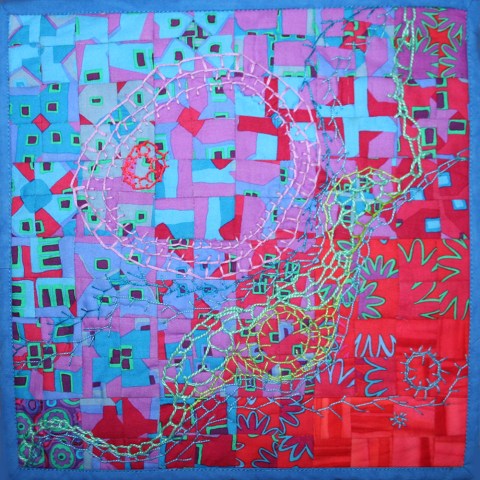
The art quilting group I belong to held a “brown bag challenge.” No, we didn’t make quilts out of brown bags! We were each given a plain brown paper lunch bag and asked to put three items into it, with which a small 12″x12″ art quilt could be made. We exchanged bags anonymously and had two months to create something artful for the contributor.
The bag I selected contained three pieces of fabric – saturated hand-dyes in cherry red and marine blue, and some Kaffe Fasset Shanty Town in the same colorway — and some green perle cotton floss.

The contents of my challenge bag

Shanty Town Purple by Brandon Mably for Kaffe Fassett Collection Westminster
I needed to sleep on it.
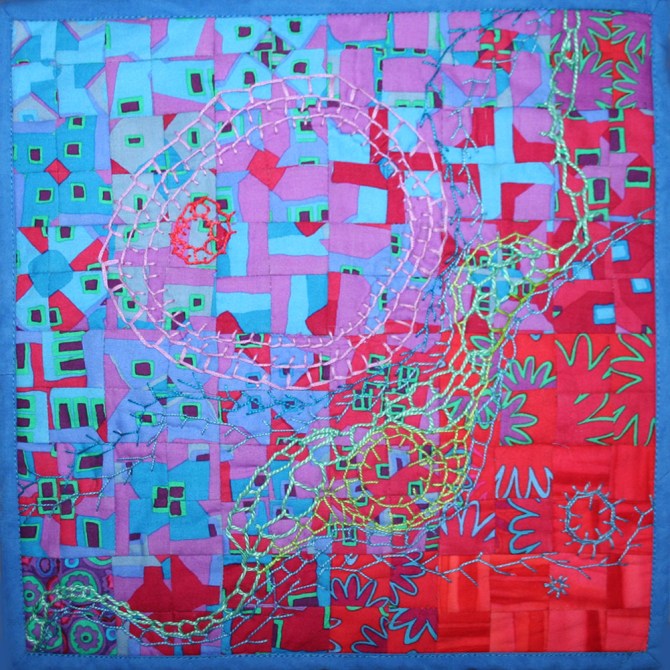
I decided to do a modified “stack and whack” with that house print. Stack-and-whack usually involves cutting 8 identical triangle blocks and rotating them to form an 8-sided kaleidoscope effect. I only had 4 repeats of the pattern available, so I cut tiny 1.5″ squares, rotated them and joined them to form 2″ finished sized blocks.
I added some of the red, because it had nice directional streaking, and a bit of complementary Kaffe fabric from my stash. I arranged the tiny blocks in a corner-to-corner color wave from blue to purple to red, with fun pops of green from the prints.
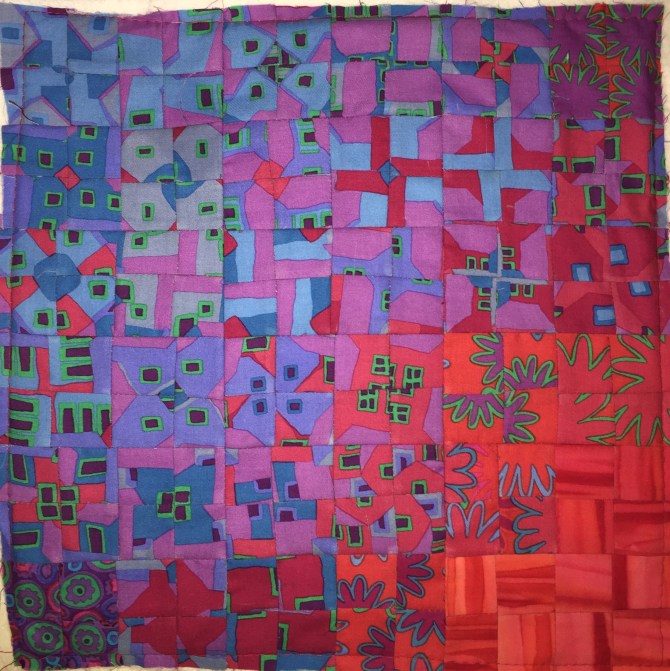
The assembled top, 13″x 13″
But I wasn’t finished. The agreement was to use a recognizable amount of each of the contributed items. I still had green embroidery cotton to feature somehow.
I needed to sleep on it again.
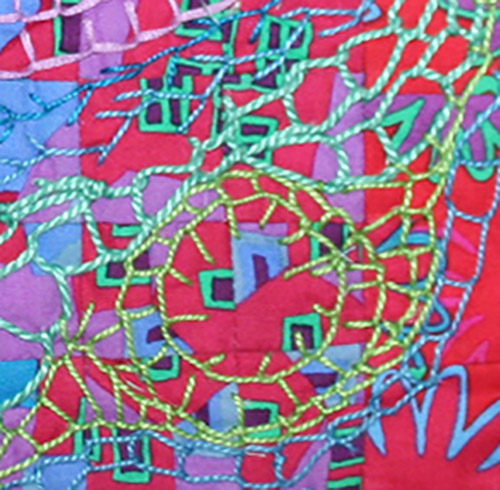
So many angles in that Shanty Town print. So many squares in my piecing. The quilt needed something soft, curvy, organic. And I could introduce that with embroidery.
I chain-, blanket- and feather-stitched an insect-like web right over that angular grid of whacked houses. I kind of love the results.
Last week I had the most fun experience attending Craft Napa 2017 in Napa California!
It was a whirlwind three days of sewing, glueing, cutting, sharing, learning and laughing!
I took three workshops, each taught incredibly well by a different very talented artist.
With Lyric Kinard‘s “Crazy Collaborative Collage” workshop, we went back to the basic elements of design: color, value, line, shape and texture; and practiced design principles of balance, relationship, focal point, repetition and unity.
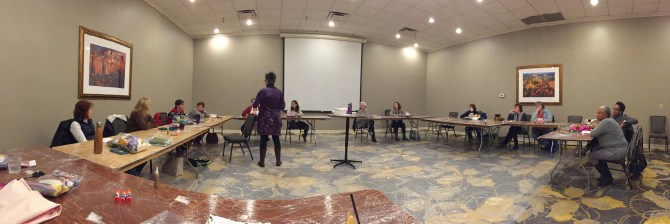
Lyric’s workshop
Lyric made it different and fun by having us practice these principles while collaborating on fabric-collage. You never knew when she was going to ask you to pass your piece to your neighbor, or get up and move to somebody else’s supplies. By doing so, she ensured we stayed focused in the process and did not get attached to the outcome, thereby enforcing her rule #1: no masterpieces!
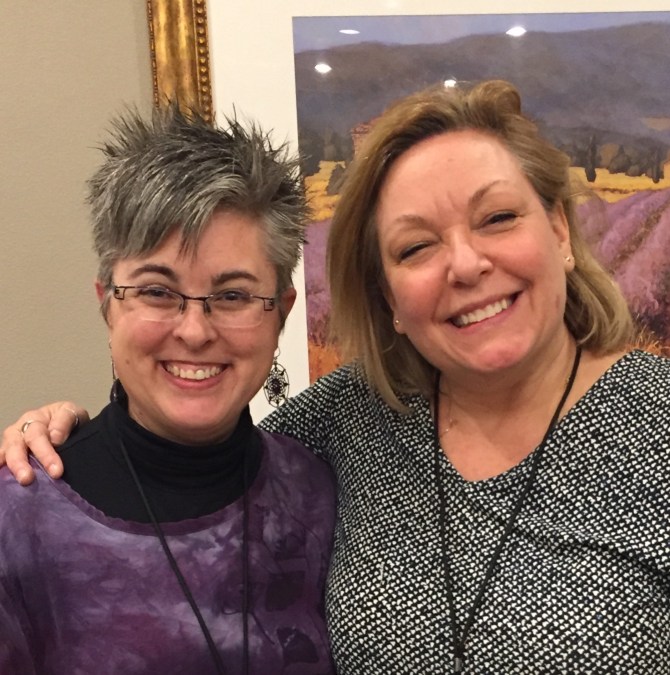
Lyric Kinard and me
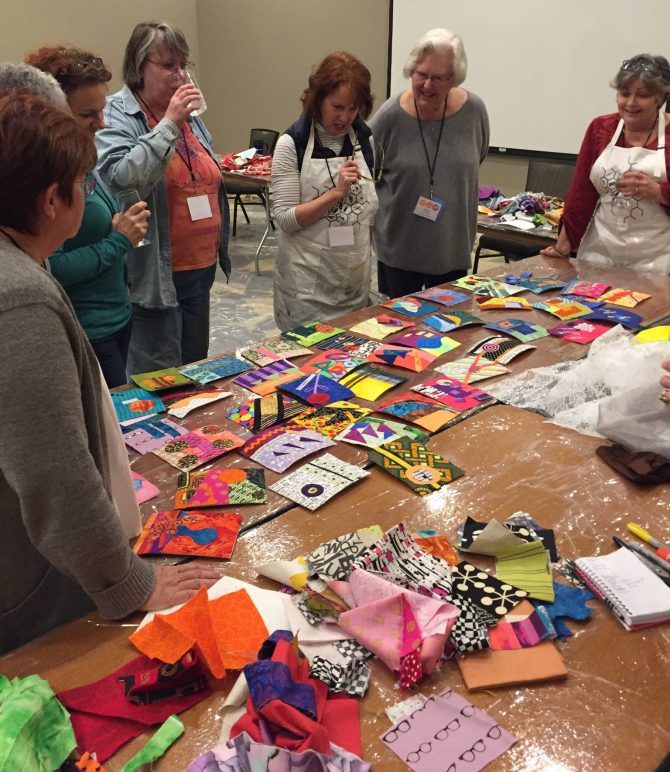
Classmates in Lyric’s class look over the fabric postcards we made.
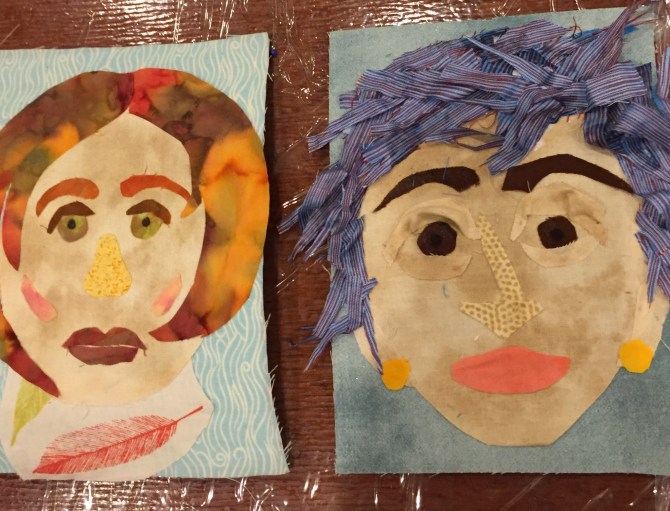
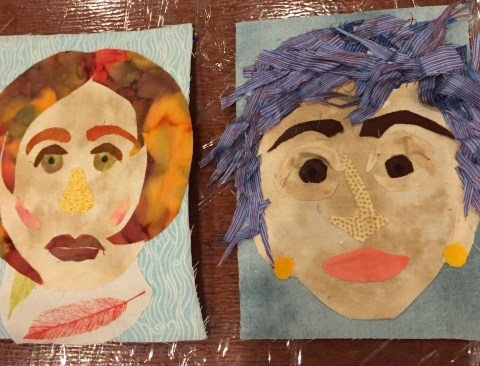
Face cards that a classmate and I made of each other. Don’t yell Lyric but I think they are masterpieces 😉
In Victoria Findlay Wolfe‘s “Thunderstruck Star Improv” workshop we used her diamond acrylic template, learned improve slashing, accurate corner piecing and Y-seams while working toward a modern take on the traditional LeMoyne star. Victoria blogged about the class here.
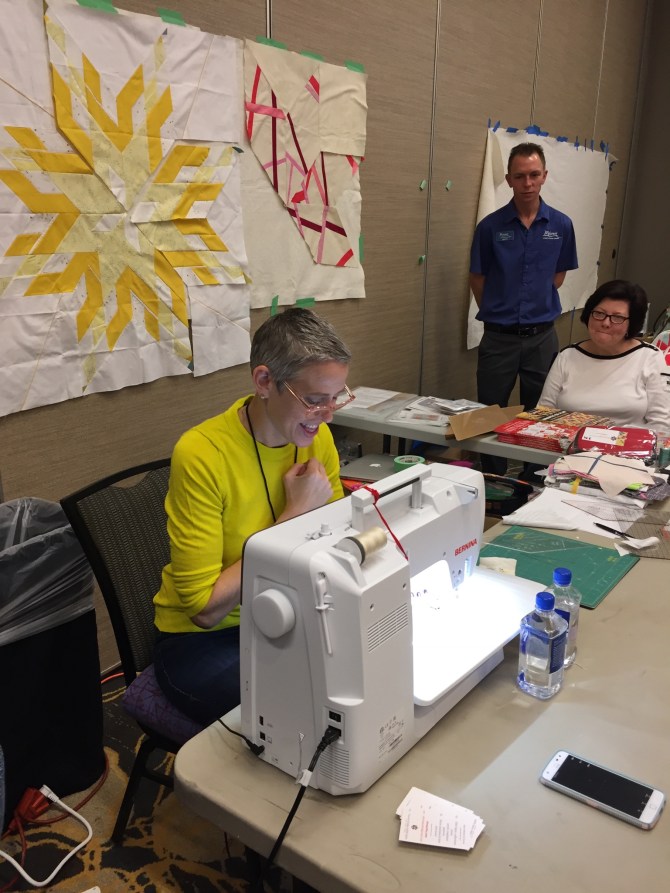
Victoria Findlay Wolfe at the sewing machine
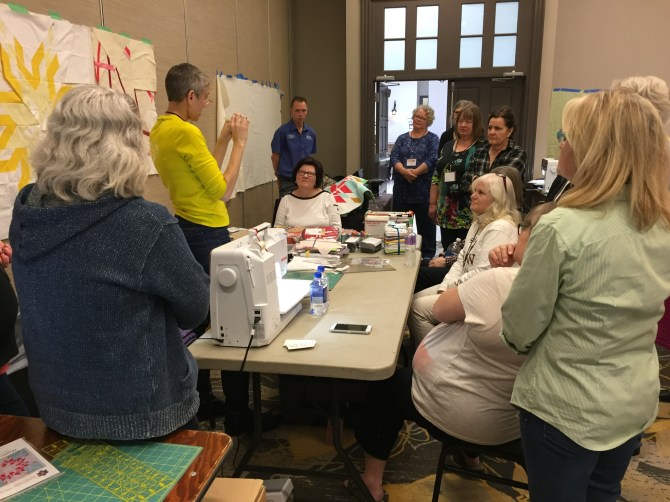
Victoria Findlay Wolfe demonstrates
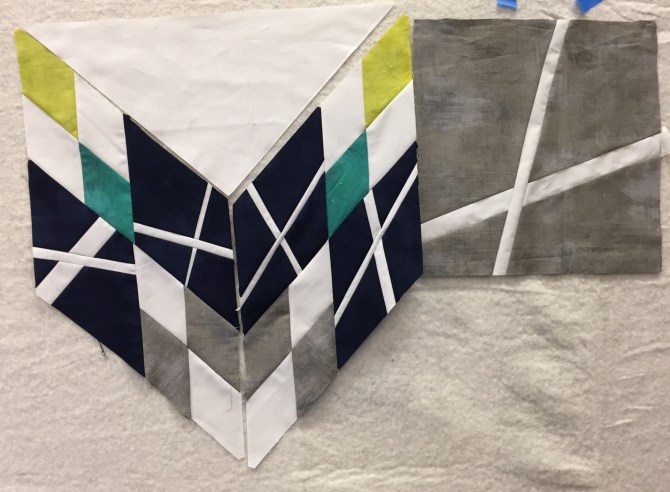
I finished one of four eventual units of the Thunderstuck Star
In Leslie Tucker Jenison’s improv piecing workshop, we played with negative space, surrounding the “leading ladies” of our bold graphic center blocks with shades of grey “supporting actors.” We learned how small insertions/inclusions of coordinating color on the grey add “wow” and unify the quilt.
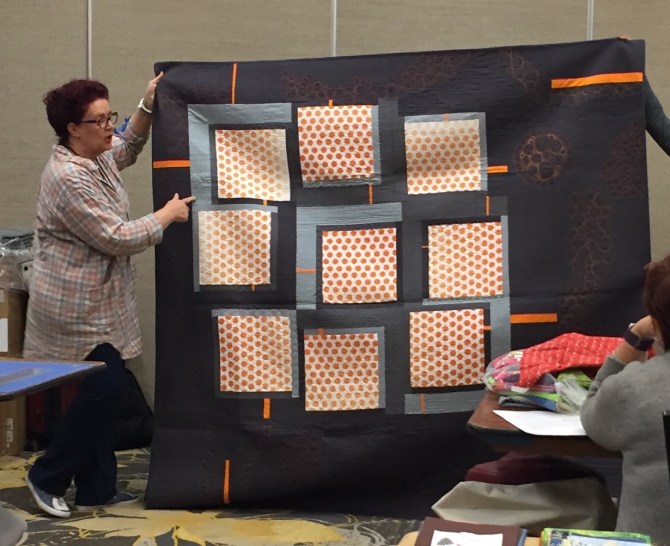
Leslie Tucker Jenison shows an example of the technique she will teach
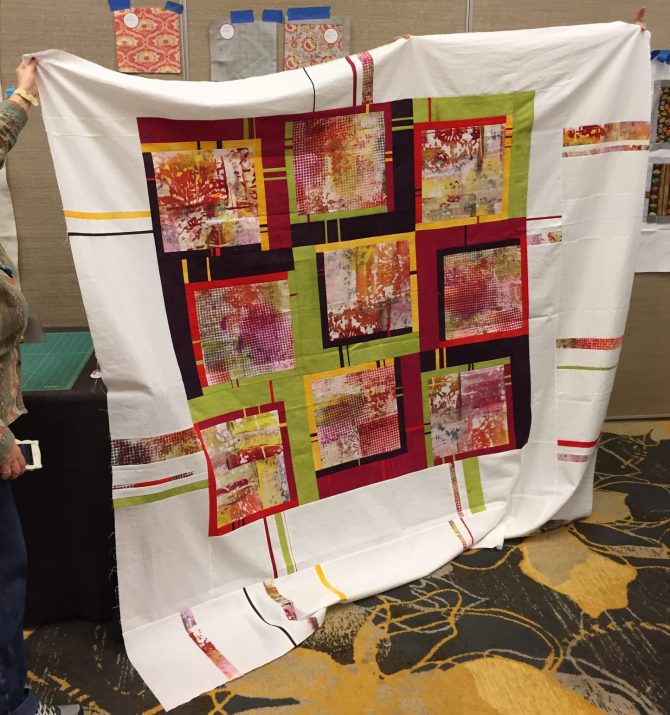
Leslie Tucker Jenison shows another example
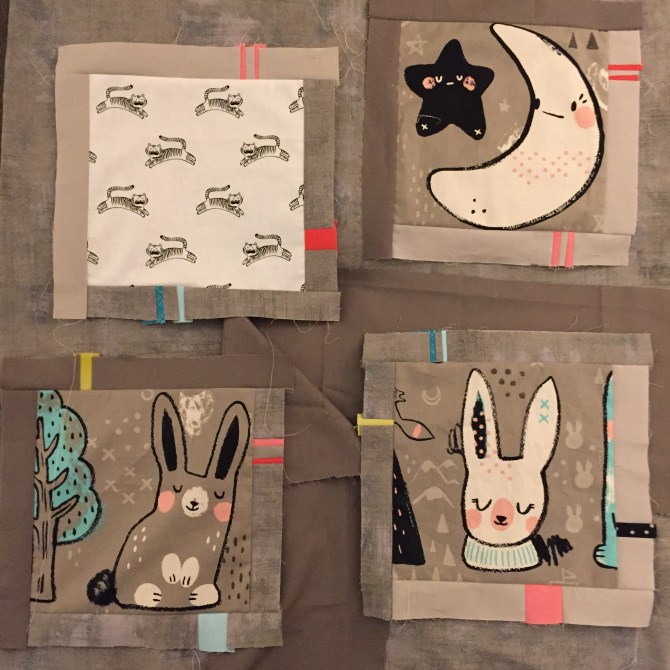
A few of the inner blocks I made during the workshop.
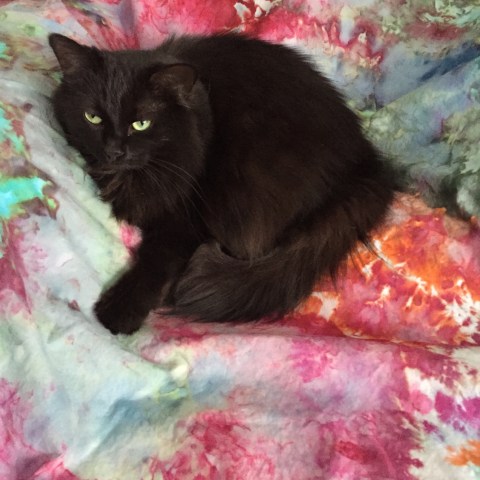
We had a snow day today, so I used the unexpected bonus time and bonus snow to do some snow-dyeing.

Step 1: soak cotton fabric in soda-ash solution, crumple up and place on drainage rack in plastic tub.

Step 2: cover with several inches of fresh snow
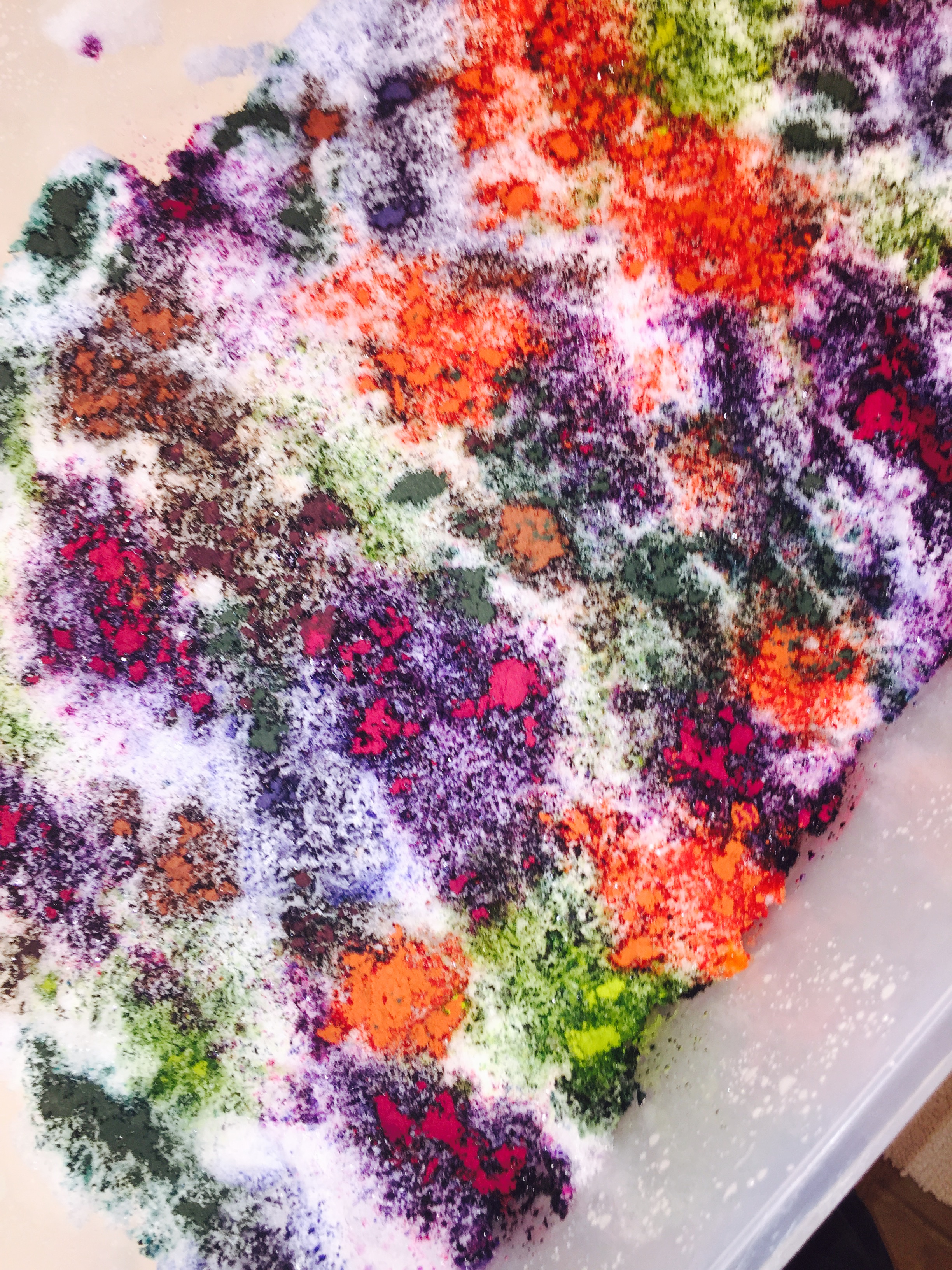
Step 3: sprinkle fiber-reactive dye powder on snow. I use Procion MX.
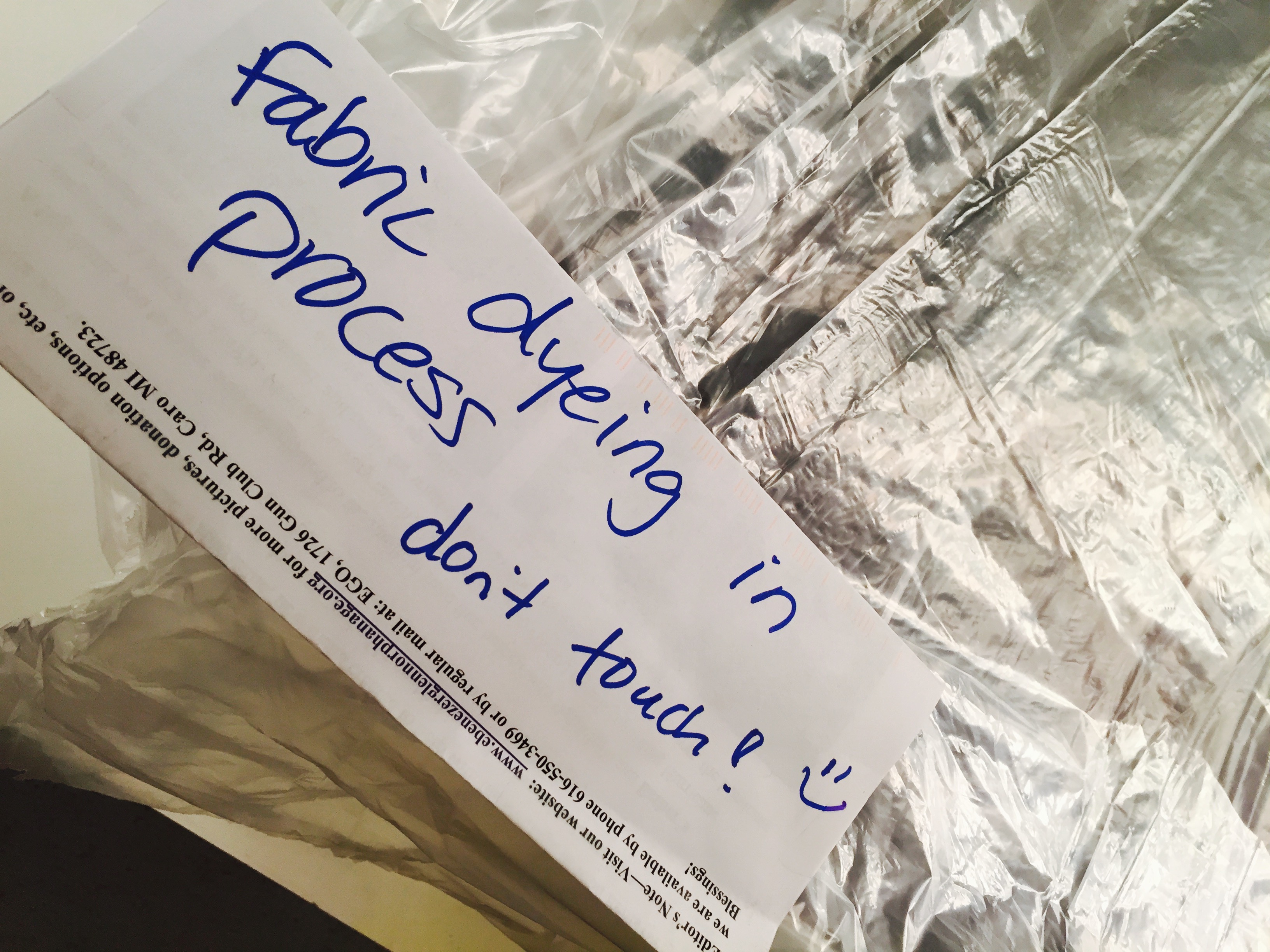
Step 4: Cover and wait 24 hours.

Step 5: uncover and be amazed. Rinse in cold water until water runs clear. Wash with synthrapol and dry.

Step 6: press and be even more amazed.



My dear friend Kris is getting married next month! It’s been so heartwarming to see how happy she and her fiance are. During their recent trip to Italy she shared a photo that I think perfectly captures the adventure, beauty and happiness of their new life together.

Photo Credit Marty Green, Pezze Di Greco, Italy. April 2016
This piece measures 9.5″ x 15″ and I made it using the confetti technique -thousands of tiny bits of fabric secured with sheer tulle and free-motion quilting. I titled it “Campo di Papaveri” , which is Italian for “Field of Poppies” (I hope :-))

Migliori auguri! Best wishes, happy couple!
I recently participated in a brown bag challenge with my art quilting group. Each participant was asked to bring three items in a brown lunch bag to be used in a small art quilt. Everyone took home a random bag that wasn’t their own, and had two months to use the items to create a 12″x12″ art quilt.
I was so excited as I opened my brown bag because I knew instantly that my friend Jackie had placed the items I found within it.
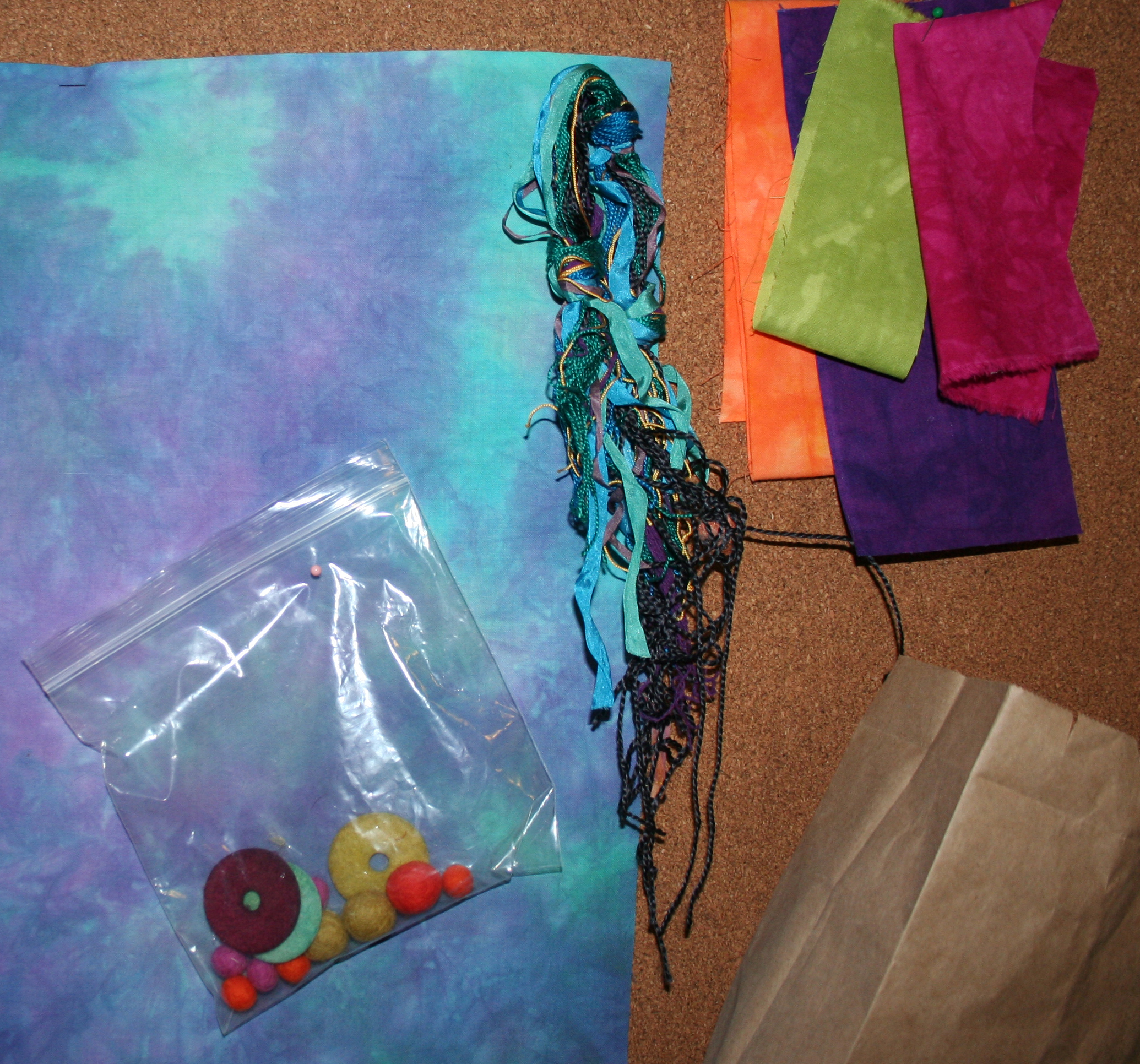
It contained cuts of 5 hand-dyed fabrics, a baggie of colorful marble-sized woolen balls and half-dollar-sized woolen discs, and a playfully tied bundle of silk ribbon and perle cotton embroidery floss.

The planning begins! A preliminary layout for the fabric, and a sketch for the embroidery.

The pieced base layer takes shape. Jackie’s hand-dyes were supplemented with a few from my stash.
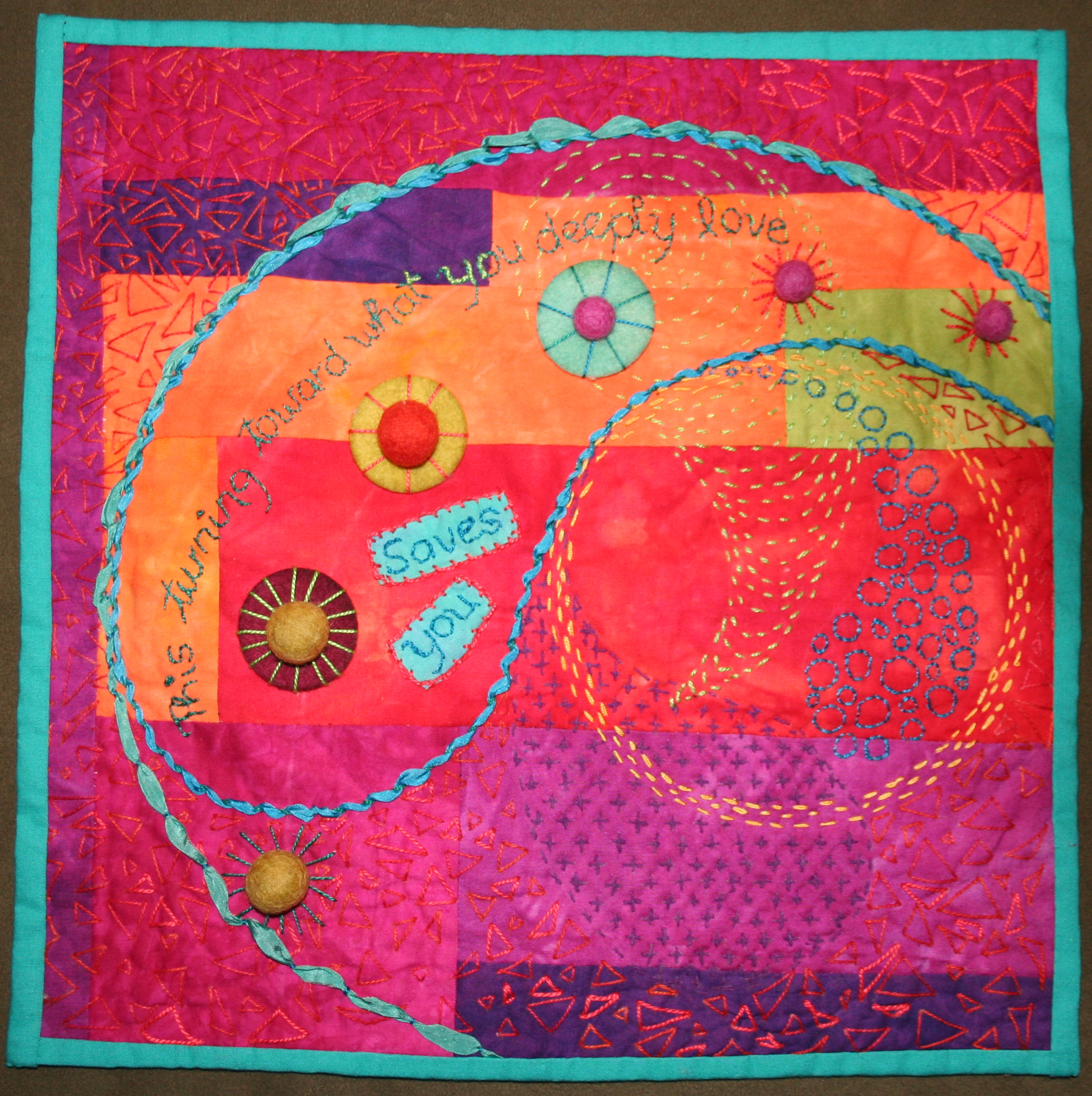
The completed piece. The original design was rearranged to incorporate a quote from Rumi that I heard while working on the embroidery: “This turning toward what you deeply love saves you.” It resonated with me in a way that I thought Jackie might feel too.
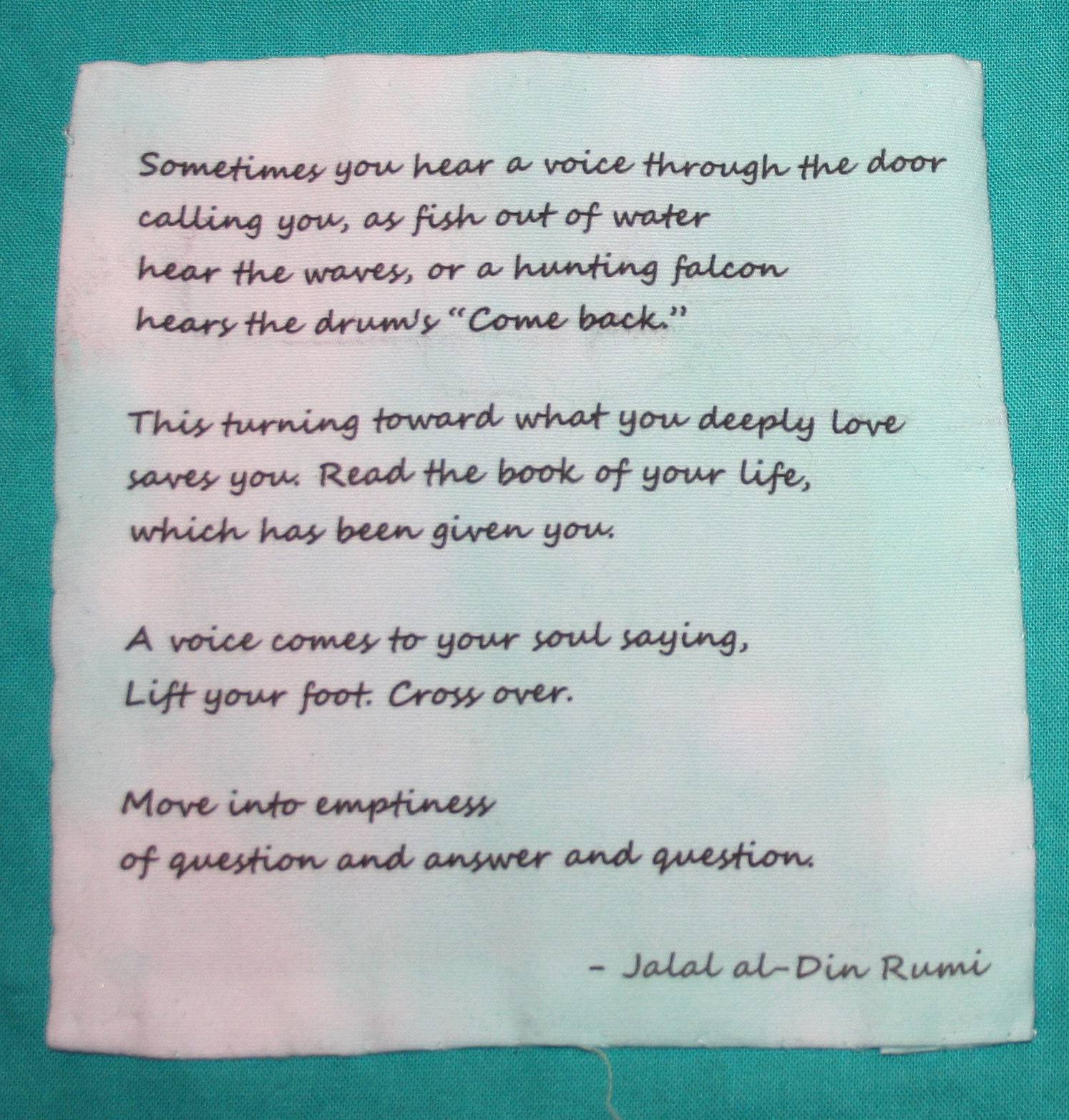
The complete poem is printed onto fabric and applied to the back side.


So exciting — my art quilt group entered and won the “Ultimate Guild Challenge” at AQS QuiltWeek Grand Rapids 2016!


Watch the video taped the morning we were awarded the honor.
My piece is called, simply, “Treehouse.” I used hand-dyed shibori silk that I raw-edge appliqued to the background layer of commercial cotton. It’s 50″h x 30″w.


 Thread Dance